Showing posts with label history. Show all posts

Saturday, June 20, 2015

Cool Finds: A Spectaular Spectacle Case

It's no secret that I love antiques, and that I love to find the story behind them. Read about my wooden duck with a story to tell here.

In recent treasure hunting, Mama LOC and I happened upon this spectacular spectacle specimen (okay, I'll stop!)

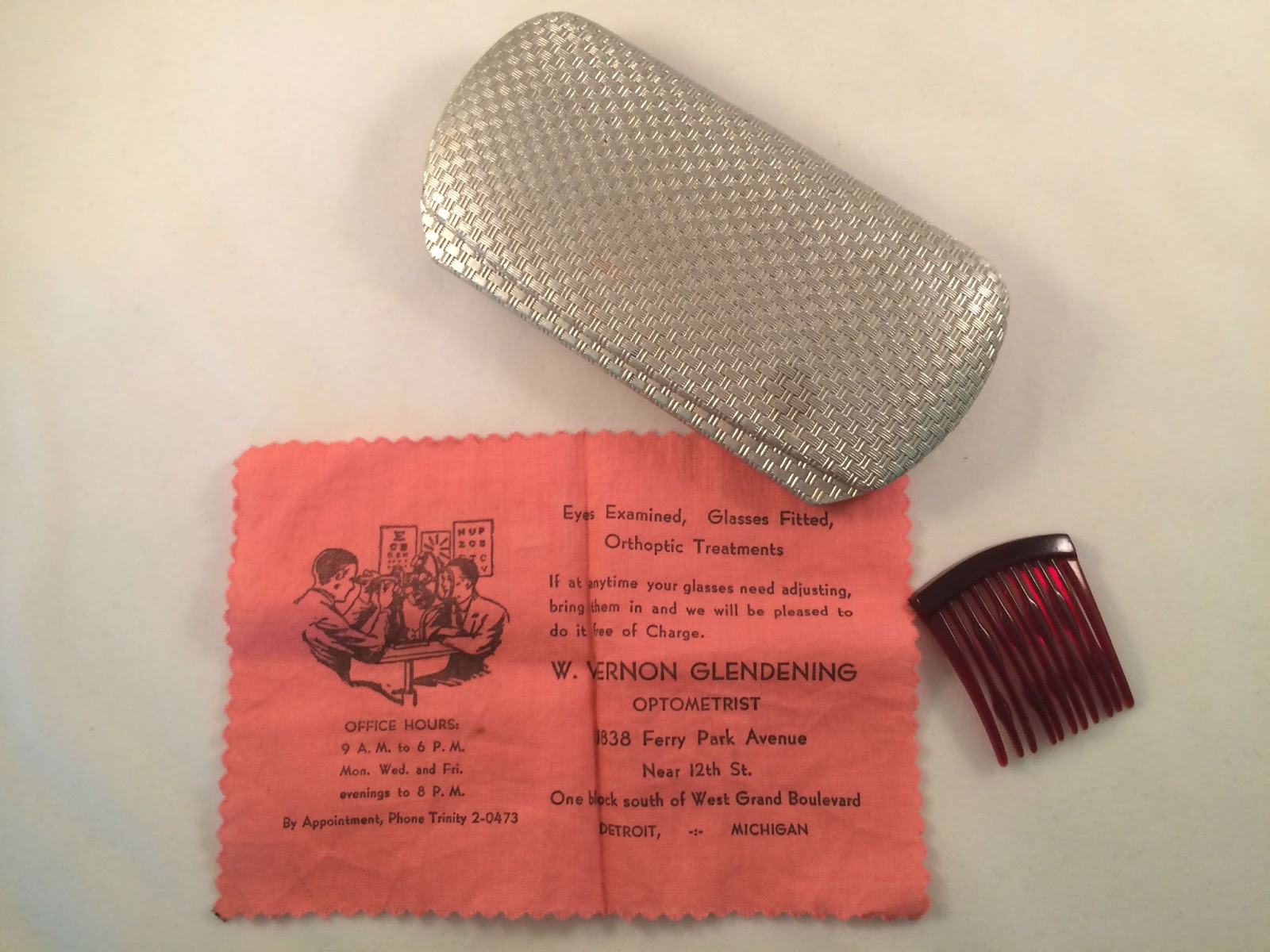
Enter this gorgeous silvertoned, metal eyeglass case.


Beautiful, eh! The metal feels light, perhaps like a tin. The inside is lined with a blue velvet, and that logo! It's some sort of a die-cut, super thin metal. Except for a hint of tarnishing, it's not bent up, and smooth.


Inside as well was a cleaning cloth. I love vintage advertising, and this is no exception. A salmon-y pink, it says:


"Eyes Examined, Glasses Fitted, Orthoptic Treatments
If at anytime your glasses need adjusting, bring them in and we will be pleased to do it free of Charge.
W. Vernon Glendening
Optometrist
1838 Ferry Park Avenue
Near 12th St.
One block south of West Grand Boulevard
Detroit, Michigan"

Left side says:
"Office hours:
9 A.M. to 6 P.M.
Mon. Wed. and Fri.
evenings to 8 P.M.
By Appointment, Phone Trinity 2-0473"

Included also was a small hair comb, but I doubt it was original to the case.

So now I needed to find a way to date it. Unfortunately, very little on the Internet exists for a quick search on W. Vernon Glendening, but I did find a few things.

1. The Optical Journal and Review of Optometry - Dated January 5, 1922.

In a slightly later edition of this volume,  W. Vernon Glendening is mentioned a few times.
On January 28th, his application to join the Detroit Society of Optometrists is received:

 And on February 25th, he receives his membership.


In yet another later edition of this volume, he attends a convention, March 22.


2. The Blue Book of Optometrists, dated 1958. 


The Blue Book of Optometrists, from what I can best decipher, is a "who's who" or a record of all the Optometrists in the United States, sorted by states, similar to a telephone book. By switching my search in Google to W.V. Glendening, we get the listing above.

Unfortunately... the trail goes cold here. Google couldn't find any other mentioning of him, not even an obituary - but keep in mind, if he's practicing Optometry and is admitted into a society in 1922, and there is still a record of him practicing in 1958, 36 years after his admittance, he would have been deceased before any modern Internet.

Making a big assumption here, but if he is born in let's say, 1896, he is admitted to a society at age 26 (I am unsure the typical entrance age of these societies), and in 1958 is 62 years old. This leads me to another clue.

3. "12th Street"
"Near Twelfth Street" in Detroit, Michigan is where this office is. Deserving of a whole other story in itself, the Riot of 1967 broke out, which has been heralded as the beginning of the "end" for Detroit. Policemen raided an after-hours drinking establishment, arresting over 80 people. While waiting for the "paddywagons" to come take these people away, the crowd that gathered, seething from tensions between the police and the community, a riot broke out, beginning as a brawl in the street. It didn't just end with a brawl. 44 people died, 1000 were injured, and over 7,000 were arrested. The National Guard was called in, with tanks and more. The President at the time, Lyndon B. Johnson went on TV to tell the nation that Detroit was out of control. It was a very bad time for Detroit. This website is a fascinating first-person view of the 1967 Riot, if you're interested.

What does this have to do with Twelfth Street? What does this have to do with our Optometrist? In 1967, Twelfth Street was documented as being a thriving business district with a substantial population. In 1958, we know W. Vernon Glendening is still in business, although we don't know for how much longer. Using the math from earlier, if we estimate he was born in roughly 1896, in 1967 he would be 71 years old.

The Michigan Daily newspaper out of Ann Arbor, on October 16, 1975 writes about a coming name change for Twelfth Street.
And jump they did - later on in 1976, Twelfth Street is changed to Rosa Parks Blvd. If our Optometrist is born in 1896, in 1976, he is 80 years old, most probably not in business any longer, if not possibly deceased. So, we definitely know that the case is older than 1976. (yes, the style already kind of tells me that, I know. We're getting there. :))

4. Detroit
Detroit is notorious and unfortunately, synonymous with ruin.
As a fellow Michigander, the ruin of Detroit is incredibly unfortunate.
Using Google's wonderful satellite imagery, and the ability to "walk" the street, I can see that the address, 1838 Ferry Park Ave. is still there.

But when I zoom in - a grocery store, which appears to be abandoned now sits where once was a optometrist, giving out this very eyeglass case and eyeglass cleaning cloth to someone who wanted to keep their vision safe and sound. Times change, of course, but it does make you wonder how places come to be.


Little pieces like this eyeglass case give us clues and hints to a different time, a way to "see" back to perhaps, a better time in a city's history.


5. Style
The style of the case, plus the date tells us it's before the 70's. The case itself is very thin - nearly only .5" tall. This tells us that it's not from the 50's or 60's, where large, horn-rimmed glasses were popular.

We know that in the early 40's, that there were scrap metal drives for the war effort. A quick Google search does not show many, if nearly any cases that were metal. This can mean one of two things a) this case is from the 30's or b) this case was not donated for the war effort. Tsk! ;)

The logo is stylized, with an Art Deco feel - it is streamlined and geometric. The Art Deco period also saw materials used like chrome and stainless steel - a distinct possibility for this metal.

This would also be about the right time period for him and his business if we're going with being born in 1896 - if in 1935 he is 39 years old, his business is established and doing well enough to procure these stylized cases and cloths.

So, by process of elimination, and with the other clues here, I can say with some confidence that this case is from 1930 to maybe 1940.

With some certainty, I can say that this case *puts sunglasses on*... is closed. (YEAAAAAHHH)
I hope you enjoyed this little tour through the history of this eyeglass case! It is available in my Etsy store, along with other "relics" of our past. Thanks for reading!

For Sale, Here
Psst - Know something I don't here? I definitely am not an expert and don't claim to be one, so if you see anything you can verify or lend a hand to, please let me know!


Thursday, May 14, 2015

Brand Feature: The History of Victoria's Secret

It's no secret that I love to sell Victoria's... Secret. Ba dum tss They make gorgeous lingerie, it's fun and different every time for me to run across and I enjoy selling every piece.

The history of Victoria's Secret is fragmented all over the Internet, and I have attempted to write a brief history from various sources, because I think it's just fascinating.

-----
There are rumors and controversies, sexuality and mystery aligned with the brand.

Founded by Roy Raymond and his Gaye on June 12, 1977, Victoria's Secret was born out of a taboo of the times. Underwear was something bought nearly exclusively in packs of 3 and bras, only a basic necessity. Anything out of the ordinary was not easy to find, and was only reserved for special moments, like honeymoons. Undergarments were dowdy and pragmatic, nothing more.

Raymond had went to purchase something nice for his wife, but was met with rows of nylon housecoats, gowns and terrycloth abound. He also said that the saleswomen made his feel uncomfortable, as a outsider in a place he did not belong.

Borrowing a total of $80,000 dollars from his parents and from the bank, Raymond studied the market for 8 years, then opened the first store that men could feel comfortable buying lingerie - Victoria's Secret in Palo Alto, California in a shopping mall that would eventually hold the first mini Apple Retail Store.

The idea took off, grossing $500,000 in the first year. $500,000.00 in 1977 had the same buying power as $2,017,285.22 in 2015. Annual inflation over this period was 3.74%. (1) Growth happened quickly, opening four new stores, warehouse operations and a mail-order catalog, all by 1982. Remember the times here still - not every husband or every wife was still comfortable with going into a store like this. Mail-order sales account for 55% of the annual sales numbers, $7 million annually. (2) $7,000,000.00 in 1980 had the same buying power as $21,430,039.11 in 2015. Annual inflation over this period was 3.25%. (3)

Original Victoria's Secret logo


As much money as this was for the era, it was having a hard time being profitable. Raymond's philosophy and focus of selling to men was sending the company towards bankruptcy. In 1982, Raymond sells the company to Leslie Wexner of The Limited. The figure was not disclosed until much later, but the number is almost shocking and sad - Raymond sells for a paltry $1 million dollars. (4) This number is disputed in various other sources as being close to $4 million dollars.

Not much is known about Raymond's personal life after this, but in 1984, he invests in a children's clothing boutique called My Child's Destiny, a far cry from the lingerie business, to the tune of approximately $1 million dollars. The brand went bankrupt in 1986. Between '86 and '93, Raymond's life takes a turn somehow and on August 26th, 1993 the original founder of what would become the world's largest lingerie empire takes his own life by leaping from the Golden Gate Bridge. He was 47.

Wexner does what probably should have been done before: he eliminates the model of marketing to men to instead, market to women. The model changed to sell lingerie and underwear in "new colors, patterns and styles that promised sexiness packaged in a tasteful, glamorous way and with the snob appeal of European luxury." (5) Mail order catalogs even utilized a fake address in London for their headquarters, which were actually based out of Columbus, Ohio. Each store was redesigned to invoke 19th century England.

Not 5 years after the purchase, the boutiques exploded into a 346 stores retailer, moving into malls across America. By 1986, it is reported that Victoria's Secret is the only national chain of lingerie stores. While there are still Fredrick's of Hollywood, Vanity Fair and the like, Victoria's Secret had surged ahead to become a chain.

The news of Victoria's Secret market takeover prompts brands like Playtex, Wacoal, and more to add new features to their once basic underthings, such as lace and "WOW" - Playtex's "new" "without wire" bra. Even Fredrick's of Hollywood, the only real player at the time in the more sexual, sensual outfits feels the pressure and launches a more demure line "Soft as Silk," featuring camisoles and chemises in soft, muted pastel colors. (6)

In 1991, Victoria's Secret releases their first line of fragrances under a line called Victoria's Secret Beauty, a slow reach into yet another profitable product. From here on out, Victoria's Secret begins digging their heels into every woman's wants and needs. And it works!

But the early 90's were not all roses. From the fast growth, among many other things, comes quality problems. The problems could be attributed to a growing/aging population as well that were looking for a better product to spend their money on as they aged.
"Its stores and catalogs - long on glitz and image--have sold apparel short on quality. That was fine during The Limited's boom days, when it ran circles around department stores with flashy, up-to-date mall shops. But Gross admits that as his core "twenty-something" customer moved into her 30s, she balked at pants with no linings and plastic buttons that popped off." (7)
As the company worked to resolve the quality problems, the profit margins tightened as a result, as higher quality production, fabrics and more had to be used to satisfy the customer. In 1995, Victoria's Secret begins to build it's very first foray into the Internet - an e-commerce site. Remember, this is the early days of (public) Internet, where the Internet is not rife with free coding or plug-ins for simple e-commerce. After 3 years of development, it launches at 6:00 pm on December 4, 1998, using the domain VictoriasSecret.com. It didn't take long for the website to catch on - in fact, it only took 20 minutes. At 6:20 pm, the first order was placed from Littleton, Colorado, for $39. (8)

In an effort to drive a higher margin, Victoria's Secret entered the billion dollar + cosmetics industry in 1998, another line under Victoria's Secret Beauty.

In 1999, the Victoria's Secret Fashion show, which was notoriously hard to get tickets for, and certainly was not the television behemoth it is today, was to be streamed on the website. This lead to major hype and major advertising dollars spent to promote the stream. Print ads, TV spots and early banner ads boasted this feat and interest was incredible. A teaser ad for the fashion show was even shown during the first quarter of the 1999 Superbowl, which lead to 1 million+ web hits in 30 minutes after it was shown. This would be the first dot com commercial ever during the Superbowl. Unfortunately, when it came down to the final event, the website couldn't handle the mounds of traffic and it crashed networks all over the United States. Long story short, millions of dollars were invested into the infrastructure behind the servers and successfully handled 2 million viewers of the next year's Victoria's Secret fashion show. (8)

Victoria's Secret did something different than what many companies were doing (and some still do) at the time, when it came to their online division. Many companies were separating their companies from brick & mortar to a nearly completely different company online. Because of the continued success of the mail-order catalog, Victoria's Secret kept matching lines, styles and promotions from channel to channel to promote a consistent UX (user-experience.)

Victoria's Secret continues to grow through the 2000's - leading to store design overhauls, from less Victorian to more streamlined - think Vogue. Sexy, but elegant in a modern way. By 2006, there is over 1,000 Victoria's Secret stores across the United States that account for over 1/3 of all of the United States' intimates purchases, a $10 billion dollar industry. (9)

Victoria's Secret celebrates their 38th anniversary in a little less than a month from today. Yet, the brand doesn't "feel" old. Constantly reinventing themselves, the brand still feels fresh, youthful and sexy to every generation it touches, quite literally.

----

And there you have it - a brief overview of the brand behemoth that is Victoria's Secret. There are many mini brands in there too that I would love to cover too - but until then, I have some bras to sell. ;)

You can see what Victoria's Secret bras I have to sell in my store right now here!


1), 3) http://www.dollartimes.com/calculators/inflation.htm
2) http://www.nytimes.com/1982/05/15/style/luxury-lingerie-a-mail-order-success.html
4) http://www.nytimes.com/1993/09/02/obituaries/roy-raymond-47-began-victoria-s-secret.html
5) Anna Tomasino (2007). Discovering popular culture. Pearson Longman. p. 57. ISBN 978-0-321-35596-6. Retrieved October 10, 2012.
6) http://www.nytimes.com/1986/08/24/business/lingerie-s-great-leap-forward.html 
7) http://www.bloomberg.com/bw/stories/1993-05-23/did-leslie-wexner-take-his-eye-off-the-ball
8) Durbin, Theodore (2002). "Victoria's Secret" (PDF). Tuck School of Business at Dartmouth—Glassmeyer/McNamee Center for Digital Strategies (6–0014). Retrieved December 16, 2012.
9) http://query.nytimes.com/gst/fullpage.html?res=9D05E4DC1F30F936A25754C0A9609C8B63

Showing posts with label history. Show all posts

Saturday, June 20, 2015

Cool Finds: A Spectaular Spectacle Case

It's no secret that I love antiques, and that I love to find the story behind them. Read about my wooden duck with a story to tell here.

In recent treasure hunting, Mama LOC and I happened upon this spectacular spectacle specimen (okay, I'll stop!)

Enter this gorgeous silvertoned, metal eyeglass case.


Beautiful, eh! The metal feels light, perhaps like a tin. The inside is lined with a blue velvet, and that logo! It's some sort of a die-cut, super thin metal. Except for a hint of tarnishing, it's not bent up, and smooth.


Inside as well was a cleaning cloth. I love vintage advertising, and this is no exception. A salmon-y pink, it says:


"Eyes Examined, Glasses Fitted, Orthoptic Treatments
If at anytime your glasses need adjusting, bring them in and we will be pleased to do it free of Charge.
W. Vernon Glendening
Optometrist
1838 Ferry Park Avenue
Near 12th St.
One block south of West Grand Boulevard
Detroit, Michigan"

Left side says:
"Office hours:
9 A.M. to 6 P.M.
Mon. Wed. and Fri.
evenings to 8 P.M.
By Appointment, Phone Trinity 2-0473"

Included also was a small hair comb, but I doubt it was original to the case.

So now I needed to find a way to date it. Unfortunately, very little on the Internet exists for a quick search on W. Vernon Glendening, but I did find a few things.

1. The Optical Journal and Review of Optometry - Dated January 5, 1922.

In a slightly later edition of this volume,  W. Vernon Glendening is mentioned a few times.
On January 28th, his application to join the Detroit Society of Optometrists is received:

 And on February 25th, he receives his membership.


In yet another later edition of this volume, he attends a convention, March 22.


2. The Blue Book of Optometrists, dated 1958. 


The Blue Book of Optometrists, from what I can best decipher, is a "who's who" or a record of all the Optometrists in the United States, sorted by states, similar to a telephone book. By switching my search in Google to W.V. Glendening, we get the listing above.

Unfortunately... the trail goes cold here. Google couldn't find any other mentioning of him, not even an obituary - but keep in mind, if he's practicing Optometry and is admitted into a society in 1922, and there is still a record of him practicing in 1958, 36 years after his admittance, he would have been deceased before any modern Internet.

Making a big assumption here, but if he is born in let's say, 1896, he is admitted to a society at age 26 (I am unsure the typical entrance age of these societies), and in 1958 is 62 years old. This leads me to another clue.

3. "12th Street"
"Near Twelfth Street" in Detroit, Michigan is where this office is. Deserving of a whole other story in itself, the Riot of 1967 broke out, which has been heralded as the beginning of the "end" for Detroit. Policemen raided an after-hours drinking establishment, arresting over 80 people. While waiting for the "paddywagons" to come take these people away, the crowd that gathered, seething from tensions between the police and the community, a riot broke out, beginning as a brawl in the street. It didn't just end with a brawl. 44 people died, 1000 were injured, and over 7,000 were arrested. The National Guard was called in, with tanks and more. The President at the time, Lyndon B. Johnson went on TV to tell the nation that Detroit was out of control. It was a very bad time for Detroit. This website is a fascinating first-person view of the 1967 Riot, if you're interested.

What does this have to do with Twelfth Street? What does this have to do with our Optometrist? In 1967, Twelfth Street was documented as being a thriving business district with a substantial population. In 1958, we know W. Vernon Glendening is still in business, although we don't know for how much longer. Using the math from earlier, if we estimate he was born in roughly 1896, in 1967 he would be 71 years old.

The Michigan Daily newspaper out of Ann Arbor, on October 16, 1975 writes about a coming name change for Twelfth Street.
And jump they did - later on in 1976, Twelfth Street is changed to Rosa Parks Blvd. If our Optometrist is born in 1896, in 1976, he is 80 years old, most probably not in business any longer, if not possibly deceased. So, we definitely know that the case is older than 1976. (yes, the style already kind of tells me that, I know. We're getting there. :))

4. Detroit
Detroit is notorious and unfortunately, synonymous with ruin.
As a fellow Michigander, the ruin of Detroit is incredibly unfortunate.
Using Google's wonderful satellite imagery, and the ability to "walk" the street, I can see that the address, 1838 Ferry Park Ave. is still there.

But when I zoom in - a grocery store, which appears to be abandoned now sits where once was a optometrist, giving out this very eyeglass case and eyeglass cleaning cloth to someone who wanted to keep their vision safe and sound. Times change, of course, but it does make you wonder how places come to be.


Little pieces like this eyeglass case give us clues and hints to a different time, a way to "see" back to perhaps, a better time in a city's history.


5. Style
The style of the case, plus the date tells us it's before the 70's. The case itself is very thin - nearly only .5" tall. This tells us that it's not from the 50's or 60's, where large, horn-rimmed glasses were popular.

We know that in the early 40's, that there were scrap metal drives for the war effort. A quick Google search does not show many, if nearly any cases that were metal. This can mean one of two things a) this case is from the 30's or b) this case was not donated for the war effort. Tsk! ;)

The logo is stylized, with an Art Deco feel - it is streamlined and geometric. The Art Deco period also saw materials used like chrome and stainless steel - a distinct possibility for this metal.

This would also be about the right time period for him and his business if we're going with being born in 1896 - if in 1935 he is 39 years old, his business is established and doing well enough to procure these stylized cases and cloths.

So, by process of elimination, and with the other clues here, I can say with some confidence that this case is from 1930 to maybe 1940.
With some certainty, I can say that this case *puts sunglasses on*... is closed. (YEAAAAAHHH)
I hope you enjoyed this little tour through the history of this eyeglass case! It is available in my Etsy store, along with other "relics" of our past. Thanks for reading!

For Sale, Here
Psst - Know something I don't here? I definitely am not an expert and don't claim to be one, so if you see anything you can verify or lend a hand to, please let me know!


Thursday, May 14, 2015

Brand Feature: The History of Victoria's Secret

It's no secret that I love to sell Victoria's... Secret. Ba dum tss They make gorgeous lingerie, it's fun and different every time for me to run across and I enjoy selling every piece.

The history of Victoria's Secret is fragmented all over the Internet, and I have attempted to write a brief history from various sources, because I think it's just fascinating.

-----
There are rumors and controversies, sexuality and mystery aligned with the brand.

Founded by Roy Raymond and his Gaye on June 12, 1977, Victoria's Secret was born out of a taboo of the times. Underwear was something bought nearly exclusively in packs of 3 and bras, only a basic necessity. Anything out of the ordinary was not easy to find, and was only reserved for special moments, like honeymoons. Undergarments were dowdy and pragmatic, nothing more.

Raymond had went to purchase something nice for his wife, but was met with rows of nylon housecoats, gowns and terrycloth abound. He also said that the saleswomen made his feel uncomfortable, as a outsider in a place he did not belong.

Borrowing a total of $80,000 dollars from his parents and from the bank, Raymond studied the market for 8 years, then opened the first store that men could feel comfortable buying lingerie - Victoria's Secret in Palo Alto, California in a shopping mall that would eventually hold the first mini Apple Retail Store.

The idea took off, grossing $500,000 in the first year. $500,000.00 in 1977 had the same buying power as $2,017,285.22 in 2015. Annual inflation over this period was 3.74%. (1) Growth happened quickly, opening four new stores, warehouse operations and a mail-order catalog, all by 1982. Remember the times here still - not every husband or every wife was still comfortable with going into a store like this. Mail-order sales account for 55% of the annual sales numbers, $7 million annually. (2) $7,000,000.00 in 1980 had the same buying power as $21,430,039.11 in 2015. Annual inflation over this period was 3.25%. (3)

Original Victoria's Secret logo


As much money as this was for the era, it was having a hard time being profitable. Raymond's philosophy and focus of selling to men was sending the company towards bankruptcy. In 1982, Raymond sells the company to Leslie Wexner of The Limited. The figure was not disclosed until much later, but the number is almost shocking and sad - Raymond sells for a paltry $1 million dollars. (4) This number is disputed in various other sources as being close to $4 million dollars.

Not much is known about Raymond's personal life after this, but in 1984, he invests in a children's clothing boutique called My Child's Destiny, a far cry from the lingerie business, to the tune of approximately $1 million dollars. The brand went bankrupt in 1986. Between '86 and '93, Raymond's life takes a turn somehow and on August 26th, 1993 the original founder of what would become the world's largest lingerie empire takes his own life by leaping from the Golden Gate Bridge. He was 47.

Wexner does what probably should have been done before: he eliminates the model of marketing to men to instead, market to women. The model changed to sell lingerie and underwear in "new colors, patterns and styles that promised sexiness packaged in a tasteful, glamorous way and with the snob appeal of European luxury." (5) Mail order catalogs even utilized a fake address in London for their headquarters, which were actually based out of Columbus, Ohio. Each store was redesigned to invoke 19th century England.

Not 5 years after the purchase, the boutiques exploded into a 346 stores retailer, moving into malls across America. By 1986, it is reported that Victoria's Secret is the only national chain of lingerie stores. While there are still Fredrick's of Hollywood, Vanity Fair and the like, Victoria's Secret had surged ahead to become a chain.

The news of Victoria's Secret market takeover prompts brands like Playtex, Wacoal, and more to add new features to their once basic underthings, such as lace and "WOW" - Playtex's "new" "without wire" bra. Even Fredrick's of Hollywood, the only real player at the time in the more sexual, sensual outfits feels the pressure and launches a more demure line "Soft as Silk," featuring camisoles and chemises in soft, muted pastel colors. (6)

In 1991, Victoria's Secret releases their first line of fragrances under a line called Victoria's Secret Beauty, a slow reach into yet another profitable product. From here on out, Victoria's Secret begins digging their heels into every woman's wants and needs. And it works!

But the early 90's were not all roses. From the fast growth, among many other things, comes quality problems. The problems could be attributed to a growing/aging population as well that were looking for a better product to spend their money on as they aged.
"Its stores and catalogs - long on glitz and image--have sold apparel short on quality. That was fine during The Limited's boom days, when it ran circles around department stores with flashy, up-to-date mall shops. But Gross admits that as his core "twenty-something" customer moved into her 30s, she balked at pants with no linings and plastic buttons that popped off." (7)
As the company worked to resolve the quality problems, the profit margins tightened as a result, as higher quality production, fabrics and more had to be used to satisfy the customer. In 1995, Victoria's Secret begins to build it's very first foray into the Internet - an e-commerce site. Remember, this is the early days of (public) Internet, where the Internet is not rife with free coding or plug-ins for simple e-commerce. After 3 years of development, it launches at 6:00 pm on December 4, 1998, using the domain VictoriasSecret.com. It didn't take long for the website to catch on - in fact, it only took 20 minutes. At 6:20 pm, the first order was placed from Littleton, Colorado, for $39. (8)

In an effort to drive a higher margin, Victoria's Secret entered the billion dollar + cosmetics industry in 1998, another line under Victoria's Secret Beauty.

In 1999, the Victoria's Secret Fashion show, which was notoriously hard to get tickets for, and certainly was not the television behemoth it is today, was to be streamed on the website. This lead to major hype and major advertising dollars spent to promote the stream. Print ads, TV spots and early banner ads boasted this feat and interest was incredible. A teaser ad for the fashion show was even shown during the first quarter of the 1999 Superbowl, which lead to 1 million+ web hits in 30 minutes after it was shown. This would be the first dot com commercial ever during the Superbowl. Unfortunately, when it came down to the final event, the website couldn't handle the mounds of traffic and it crashed networks all over the United States. Long story short, millions of dollars were invested into the infrastructure behind the servers and successfully handled 2 million viewers of the next year's Victoria's Secret fashion show. (8)

Victoria's Secret did something different than what many companies were doing (and some still do) at the time, when it came to their online division. Many companies were separating their companies from brick & mortar to a nearly completely different company online. Because of the continued success of the mail-order catalog, Victoria's Secret kept matching lines, styles and promotions from channel to channel to promote a consistent UX (user-experience.)

Victoria's Secret continues to grow through the 2000's - leading to store design overhauls, from less Victorian to more streamlined - think Vogue. Sexy, but elegant in a modern way. By 2006, there is over 1,000 Victoria's Secret stores across the United States that account for over 1/3 of all of the United States' intimates purchases, a $10 billion dollar industry. (9)

Victoria's Secret celebrates their 38th anniversary in a little less than a month from today. Yet, the brand doesn't "feel" old. Constantly reinventing themselves, the brand still feels fresh, youthful and sexy to every generation it touches, quite literally.

----

And there you have it - a brief overview of the brand behemoth that is Victoria's Secret. There are many mini brands in there too that I would love to cover too - but until then, I have some bras to sell. ;)

You can see what Victoria's Secret bras I have to sell in my store right now here!


1), 3) http://www.dollartimes.com/calculators/inflation.htm
2) http://www.nytimes.com/1982/05/15/style/luxury-lingerie-a-mail-order-success.html
4) http://www.nytimes.com/1993/09/02/obituaries/roy-raymond-47-began-victoria-s-secret.html
5) Anna Tomasino (2007). Discovering popular culture. Pearson Longman. p. 57. ISBN 978-0-321-35596-6. Retrieved October 10, 2012.
6) http://www.nytimes.com/1986/08/24/business/lingerie-s-great-leap-forward.html 
7) http://www.bloomberg.com/bw/stories/1993-05-23/did-leslie-wexner-take-his-eye-off-the-ball
8) Durbin, Theodore (2002). "Victoria's Secret" (PDF). Tuck School of Business at Dartmouth—Glassmeyer/McNamee Center for Digital Strategies (6–0014). Retrieved December 16, 2012.
9) http://query.nytimes.com/gst/fullpage.html?res=9D05E4DC1F30F936A25754C0A9609C8B63

Labels

Flickr Images

Like us on Facebook

Popular Posts


Little Oak Creations Template by Ipietoon Cute Blog Design

Blogger Templates